


Fault in Stop Sign Accidents in Florida Explained
Stop sign accidents happen fast, and they are rarely as simple as they first appear. Two drivers reach an intersection, one insists the other blew through the sign, and the other insists they stopped and had the right of way. Insurance adjusters know these cases often come down to a swearing match, which is exactly why they train hard to find any reason to shift blame onto you.
At RTRLAW, our attorneys have handled car accident claims across Florida since 1988. For close to four decades, our personal injury attorneys have guided countless clients through exactly this kind of dispute, and explaining how Florida law assigns fault at a stop sign, what evidence actually proves it, and how comparative negligence can affect what you recover.
Florida’s Stop Sign Right-of-Way Rules
Florida law spells out exactly who has the right of way at a stop sign. Under Florida Statute 316.123, every driver approaching an intersection controlled by a stop sign must stop at the marked stop line, and after stopping, must yield to any vehicle already in the intersection or approaching so closely that it presents an immediate hazard.
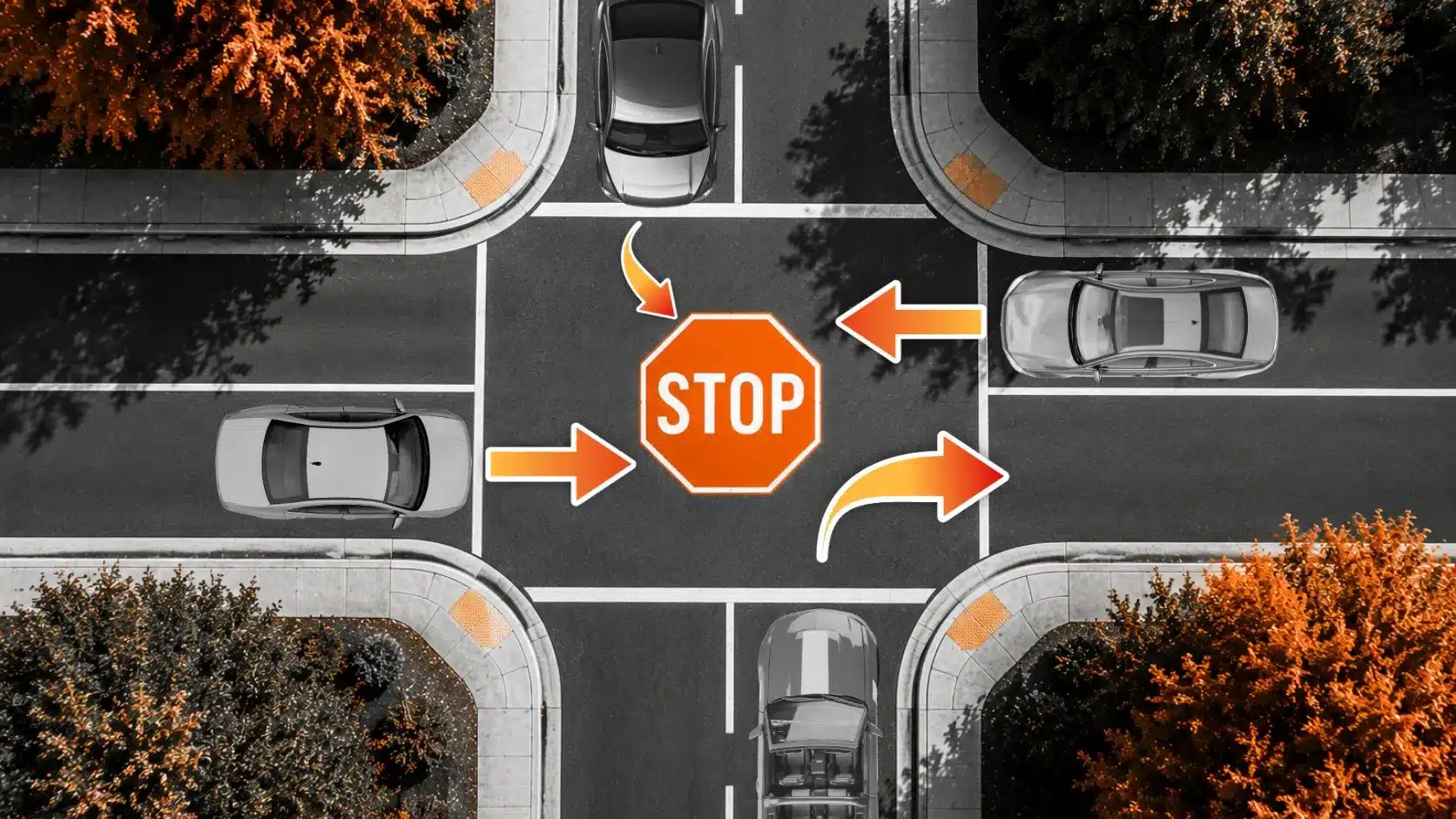
At a four-way stop, the rule is simple in theory and often contested in practice. The first driver to stop is the first to proceed. If two vehicles stop at the same time, the driver on the left must yield to the driver on the right. Disagreements over who actually stopped first, or who arrived first, are at the center of many stop sign injury claims.
| Scenario | Who Generally Has the Right of Way | Florida Statute |
| Two-way stop, cross traffic has no sign | The vehicle on the uncontrolled road, once the stopped driver may safely proceed | 316.123(2)(a) |
| Four-way stop, one driver stops first | The driver who stopped first | 316.123(2)(b) |
| Four-way stop, simultaneous arrival | The driver on the right | 316.123(2)(b) |
| Yield sign instead of stop sign | Driver must slow or stop if needed and yield to close traffic | 316.123(1) |
Emmanuel Ramos
Honestly one of the best firms I’ve had the pleasure of working with, incredibly helpful staff
How a Stop Sign Violation Affects Fault
A driver who runs a stop sign has broken the law, but that alone does not automatically decide who pays for the crash. Florida does not treat a traffic violation like a blown stop sign as automatic proof of fault. Under the framework from deJesus v. Seaboard Coast Line Railroad Co., 281 So. 2d 198 (Fla. 1973), violating a statute meant to protect the public generally, which includes traffic laws, is evidence of negligence rather than negligence as a matter of law. A documented stop sign violation still carries real weight with an insurance adjuster, a judge, or a jury, but your attorney still has to connect that violation to the crash and to your injuries with additional evidence.
That distinction matters in practice. It means the driver who ran the sign can still try to argue that something else caused or contributed to the crash, such as excessive speed by the other driver or a vehicle defect. It also means your case gets stronger, not weaker, when you back up the violation with independent evidence rather than relying on the stop sign alone.
What Causes Stop Sign Accidents in Florida
Most stop sign collisions trace back to one of a handful of recurring causes:
- Rolling stops, where a driver slows down but never fully stops before proceeding
- Distracted driving, including phone use, that causes a driver to miss the sign entirely
- Obstructed sightlines from overgrown landscaping, parked vehicles, or poorly placed signage
- Misjudging who arrived first at a four-way stop
- Excessive speed that prevents a driver from stopping in time even after seeing the sign
- A missing, faded, knocked-down, or obscured stop sign that a driver never saw
The last item on that list, a sign that was missing or impossible to see, changes the entire analysis of a case, which is why it gets its own section below.
Key Evidence Used to Prove Fault at a Stop Sign
Building a strong stop sign case means gathering more than one type of proof. The most persuasive claims combine several of the following:
- The police accident report, including any citation issued and the officer’s notes on point of impact
- Independent eyewitness statements from drivers, passengers, or pedestrians who saw which vehicle stopped
- Photographs of the intersection, the stop sign itself, skid marks, and the resting position of both vehicles
- Traffic camera or nearby business surveillance footage showing the approach to the intersection
- Dashcam footage from either vehicle or a nearby driver
- Event Data Recorder data showing each vehicle’s speed and braking in the seconds before impact
- Accident reconstruction analysis in serious or disputed cases
The physical damage pattern often tells its own story at a stop sign crash. A classic broadside or T-bone impact, where the front of one vehicle strikes the side of another, is the signature pattern of a failure to yield at an intersection, and the location of that damage can help establish which driver had already entered the intersection lawfully.
These crashes share evidence patterns with other intersection cases, including crashes where a driver ran a red light instead of a stop sign. The evidence-gathering process is similar even though the specific traffic control device is different.
Surveillance and dashcam footage matter most in the first few days after a crash. Most nearby businesses overwrite their security recordings within a week or two, and a driver’s own dashcam footage can be lost if the memory card is reused before anyone thinks to preserve it. Our team sends written preservation requests to nearby camera owners as soon as we are retained, specifically because this evidence disappears quickly and often cannot be recovered once it is gone.
How Insurance Companies Try to Shift Blame
Even when a police report favors you, the at-fault driver’s insurance company rarely accepts full responsibility without a fight. Adjusters are trained to look for any angle that reduces what they have to pay, and stop sign cases give them several common ones to work with.
- Arguing that you could have braked or swerved to avoid the collision even though you had the right of way
- Claiming you were speeding through the intersection, which would reduce the sign-runner’s own share of fault
- Disputing which driver actually stopped first at a four-way intersection
- Pointing to a gap between the crash and your first medical treatment to argue your injuries are unrelated or less severe than claimed
- Offering a fast, low settlement before you know the full extent of your injuries or property damage
None of these tactics mean your claim is weak. They mean the insurance company is doing exactly what it is trained to do. Having documented evidence, and having an attorney who recognizes these arguments before they are raised, keeps a legitimate claim from being talked down.
Pedestrians and Cyclists at Stop Sign Intersections
Stop sign crashes do not only involve two vehicles. A driver who rolls through a stop sign while watching for cross traffic can easily miss a pedestrian or cyclist who is lawfully crossing. Florida law generally gives crossing pedestrians the right of way once they have entered a crosswalk at a controlled intersection, and a driver’s obligation to stop at the sign does not disappear just because their attention was on other vehicles. For a closer look at how these rules work outside the vehicle-to-vehicle context, see our discussion of when pedestrians have the right of way in Florida.
Pedestrian and cyclist injuries at stop sign intersections also tend to be more severe than vehicle-to-vehicle crashes at the same location, simply because there is far less protection between a person and a moving car. These cases still rely on the same evidence toolkit described above, with an added focus on where exactly the pedestrian or cyclist was positioned at the moment of impact.
Two-Way Stops vs. Four-Way Stops: Why the Analysis Differs
Not every stop sign intersection works the same way, and the fault analysis changes depending on the type of intersection involved.
At a two-way stop, only one direction of traffic has a stop sign, while cross traffic has the right of way and no obligation to stop at all. Fault analysis at these intersections usually centers on whether the stopped driver waited for a safe gap before pulling out, since the driver on the uncontrolled road generally had the right of way to begin with.
At a four-way stop, every direction faces a stop sign, and the right of way depends entirely on the order of arrival. These cases often turn on split-second observations, since two drivers can genuinely, honestly disagree about who stopped first. This is exactly the kind of dispute where independent evidence, rather than each driver’s own account, tends to decide the outcome.
When the Stop Sign Itself Is the Problem
Sometimes a driver is not to blame for missing a stop sign because the sign itself failed. A sign can be knocked down by a prior collision, obscured by overgrown vegetation, faded past legibility, or simply never replaced after storm damage. When a missing or obstructed sign contributes to a crash, liability can extend to the government entity responsible for maintaining that intersection, whether a city, county, or the Florida Department of Transportation.
Claims against a government entity work differently than claims against another driver. Under Florida Statute 768.28, Florida has waived sovereign immunity for negligence claims, but recovery is capped at $200,000 per person and $300,000 per incident, and claimants generally must present a written notice of claim to the responsible agency within 3 years of the incident before filing suit. These deadlines and caps do not apply to claims against another driver, which is one of many reasons it matters to correctly identify every party who may share responsibility for your crash early on.
How Comparative Negligence Can Reduce or Bar Your Recovery
Florida follows a modified comparative negligence rule. Under Florida Statute 768.81(6), a driver who is found more than 50 percent at fault for their own harm cannot recover any damages at all. If your share of fault is 50 percent or less, your compensation is reduced by that percentage rather than eliminated.
In a stop sign case, insurers frequently argue that the driver with the right of way still shares some blame, for example by speeding, failing to brake in time, or being distracted in the moments before impact. For example, if you are found 20 percent at fault for a crash with $200,000 in total damages, you would recover $160,000 rather than the full amount. If you are found 55 percent at fault, you would recover nothing under Florida law.
What to Do When Both Drivers Blame Each Other
It is common for both drivers at a stop sign crash to insist the other one ran the sign. When that happens, the case is decided by whichever independent evidence is available, not by either driver’s own account. This is exactly why acting quickly matters.
- Call 911 and request an officer respond, even for a crash that seems minor at first
- Photograph the intersection from multiple angles, including the stop sign, skid marks, and both vehicles before they are moved if it is safe to do so
- Get contact information from any witnesses before they leave the scene
- Avoid discussing fault with the other driver or apologizing at the scene
- Seek medical attention promptly, since some injuries do not cause symptoms right away
- Contact RTRLAW as soon as possible so our team can move to preserve nearby surveillance footage before it is overwritten
When both drivers tell different stories, the evidence often becomes the deciding factor. Taking the right steps immediately after the crash can protect your health, preserve critical evidence, and strengthen your claim. If liability is disputed after a stop sign accident, the experienced auto accident attorneys at RTRLAW can investigate the collision, gather the evidence needed to establish fault, and fight to help you recover the compensation you deserve.
How Fault Actually Gets Determined
Fault in a stop sign accident is not decided by a single official the moment police leave the scene. It usually plays out in stages, and understanding those stages helps set realistic expectations.
Immediately after the crash, Florida’s no-fault insurance system means your own Personal Injury Protection coverage pays a portion of your medical bills and lost wages regardless of who caused the crash, up to your policy limits. Fault becomes central once your damages exceed what PIP covers, which is common in any crash involving real injuries.
From there, each driver’s insurance adjuster investigates independently, reviewing the police report, photos, any available footage, and each driver’s statement. Adjusters frequently disagree with each other, which is exactly when a documented, evidence-backed case matters most. If the insurance companies cannot agree, or if an insurer refuses to offer fair compensation, the dispute can move to a lawsuit, where a judge or jury ultimately assigns fault percentages if the case does not settle first.
When More Than Two Vehicles Are Involved
Stop sign intersections can produce chain-reaction crashes, particularly when one driver stops abruptly to avoid a collision and is then struck from behind, or when a driver who ran the sign collides with a vehicle that then strikes a third car. These multi-vehicle cases require sorting out fault separately for each impact, since Florida’s comparative negligence rule under Section 768.81 applies on a party-by-party basis rather than treating every involved driver the same way. It is entirely possible for one driver to bear no fault at all while two others share responsibility in different proportions.
Statute of Limitations for Stop Sign Accident Claims in Florida
Florida law gives injury victims a limited window to file suit. Under Florida Statute 95.11(5)(a), a negligence action, including most car accident injury claims, must generally be filed within 2 years of the crash. Waiting too long can permanently bar your right to recover, regardless of how clear the fault was.
What Compensation Can You Recover After a Stop Sign Accident?
If you can establish that another driver, or a responsible government entity, caused your stop sign accident, you may be entitled to recover:
- Medical expenses, both past bills and reasonably anticipated future treatment
- Lost wages and loss of future earning capacity
- Property damage to your vehicle
- Pain and suffering and loss of enjoyment of life
- Wrongful death damages for surviving family members in fatal crashes
RTRLAW has secured significant results for clients injured in intersection and high-impact accidents, including a $7 million settlement for a young woman who suffered severe injuries when a car hydroplaned on a road with improperly managed construction runoff, and more than $2 million for the family of a truck driver who died in a head-on collision. You can review additional client case results on our site. Every case is different, and outcomes depend on the specific facts and circumstances of each claim.
Frequently Asked Questions About Stop Sign Accident Fault in Florida
Is running a stop sign automatically proof that the other driver caused the crash?
Not automatically. A stop sign violation is strong evidence of negligence in Florida, but your attorney still needs to connect the violation to the crash and your injuries with independent evidence such as witness statements, photos, or video.
What if there was no stop sign visible at the intersection?
A missing, faded, or obstructed stop sign can shift some or all liability to the government entity responsible for maintaining that intersection, though these claims involve shorter notice deadlines and damage caps that do not apply to claims against another driver.
Can I still recover damages if I was partly at fault for a stop sign accident?
Yes, as long as your share of fault is 50 percent or less. Your compensation is reduced by your percentage of fault rather than eliminated, unless you are found more than 50 percent responsible.
How long do I have to file a claim after a Florida stop sign accident?
Generally 2 years from the date of the crash for a claim against another driver. Claims against a government entity for a missing or damaged sign require a written notice of claim within 3 years, but practical deadlines are often much shorter, so it is important to act quickly.
Do I need a lawyer if the police report already says the other driver ran the stop sign?
A favorable police report helps, but insurers still frequently dispute fault, argue comparative negligence, or minimize your damages. An attorney can make sure a favorable report actually translates into fair compensation.
What if the other driver claims I ran the stop sign when I actually had a green light or no sign at all?
This is common at intersections where only one direction has a stop sign. Independent evidence, such as traffic camera footage or the physical damage pattern, is usually what resolves this kind of direct factual dispute.
Does it matter if the crash happened at night or in bad weather?
Reduced visibility can make it harder to see a stop sign, but it does not eliminate a driver’s duty to obey it. Weather and lighting conditions are often part of the broader negligence analysis, particularly if a driver was traveling too fast for the conditions.
Protecting Your Rights After a Florida Stop Sign Accident
Stop sign crashes often turn into a dispute over whose word gets believed, which means the evidence you gather in the first hours and days after the crash can decide the outcome of your claim. Florida law gives you real tools, from the right-of-way rules in Section 316.123 to the protections of comparative negligence, but using those tools effectively takes experience.
RTRLAW has been fighting for Florida accident victims since 1988, true to our commitment to get justice during those “Oooo” Moments for every client we represent. If you were hurt in a stop sign accident, contact RTRLAW by calling 1-833-HIRE-RTR today for a free, no obligation case review. We handle car accident claims on a No Win, No Fee basis, and our team is available 24 hours a day, 7 days a week.