

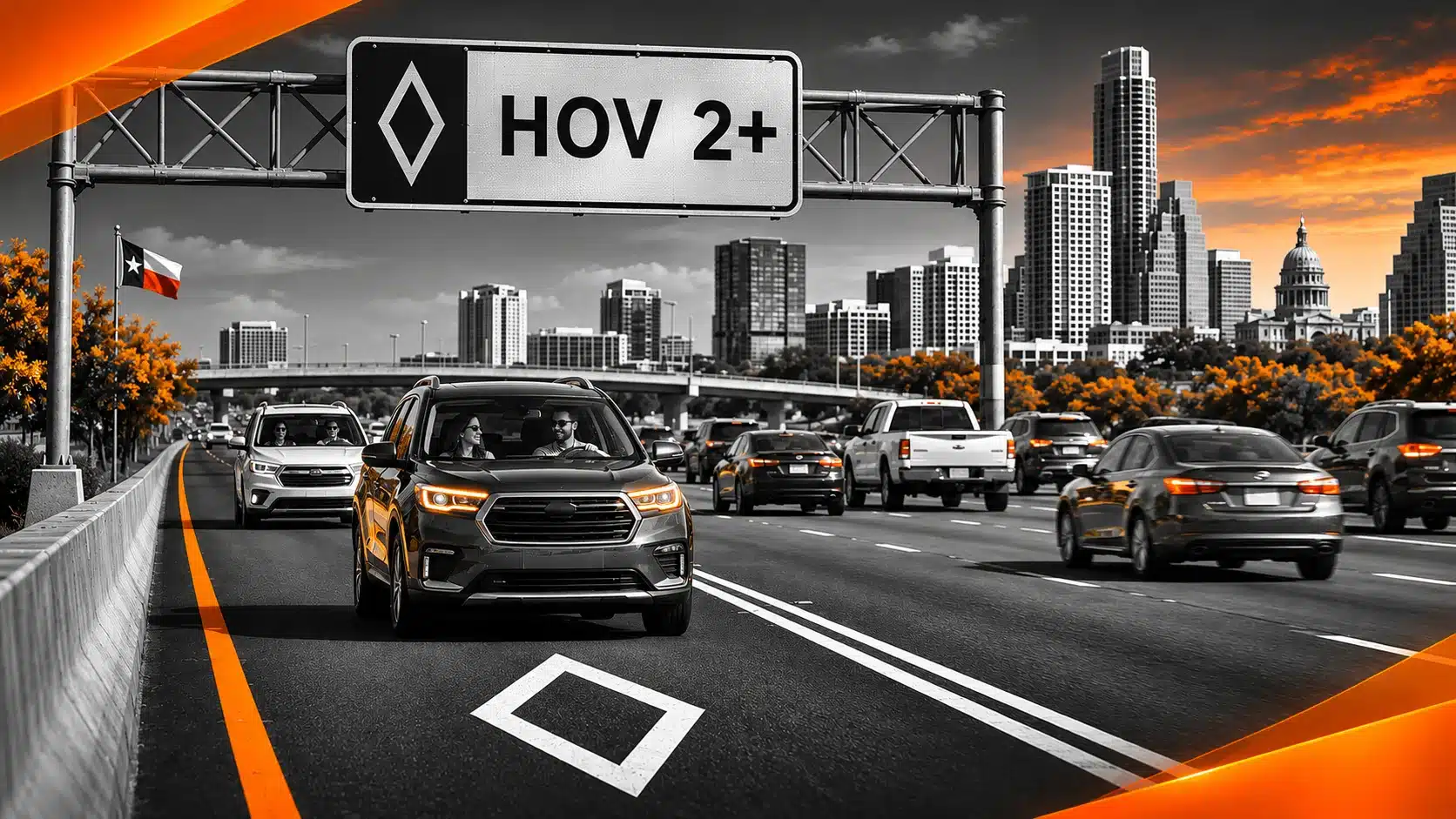

What Is the HOV Lane in Texas?
Texas HOV lanes, short for High-Occupancy Vehicle lanes, are set aside for vehicles that meet a minimum occupancy requirement, as well as certain qualifying vehicles like motorcycles, buses, and emergency vehicles. Their purpose is to encourage carpooling and public transit by moving more people through congested areas with fewer vehicles.
The exact rules are not identical across Texas. Some HOV lanes are free for qualifying vehicles, some operate as part of tolled managed-lane systems, and occupancy requirements can change depending on the highway, city, or time of day. Drivers should therefore follow the signs posted for the specific lane they are entering rather than assuming every Texas HOV lane works the same way.
What Does HOV Mean in Texas?
As mentioned earlier, HOV stands for High-Occupancy Vehicle. Texas law defines a high-occupancy vehicle as a bus or other passenger vehicle, such as a carpool or vanpool, carrying the minimum number of people specified for that particular facility.
An HOV lane is a roadway lane that gives those qualifying vehicles priority over ordinary traffic.
You may also hear HOV lanes described as:
- Carpool lanes
- Managed lanes
- Express lanes
- HOV/HOT lanes
Those terms are related, but they do not always mean the same thing.
A traditional HOV lane limits access based primarily on vehicle occupancy. A HOT lane, or High-Occupancy Toll lane, can allow vehicles that do not satisfy the occupancy requirement to enter by paying a toll. TxDOT treats both as forms of managed lanes.
Nichole Infantes
RTR is amazing they have your best interest at heart and will help you every step of the way. The attorney Nirvana is an amazing person to have on your case she truly will make sure you get the best outcome and make sure your questions are always answered!
Who Can Use an HOV Lane in Texas?
The most common Texas HOV requirement is two or more people in the vehicle, although drivers must follow the occupancy requirement posted for the particular corridor.
TxDOT says eligible vehicles on its North Texas HOV system generally include:
- Passenger cars with the required number of occupants
- Pickup trucks
- Vans
- Buses
- Motorcycles
- Emergency vehicles responding to calls
Certain large trucks and vehicles towing trailers may be prohibited. Single-occupant hybrid vehicles do not automatically qualify simply because they are fuel-efficient.
The rule can differ elsewhere in the state. Houston’s Highway 290 express lane, for example, requires at least three people during part of the morning peak period, while the requirement falls to two people during other HOV-only periods.
That is why the sign at the entrance to the lane controls.
What Does HOV 2+ Mean in Texas?
HOV 2+ means the vehicle must contain at least two people. The driver counts as one of those people, so a driver traveling with one passenger generally satisfies an HOV 2+ requirement.
This is one of the most common HOV designations in Texas.
If a sign says:
- HOV 2+
the vehicle generally needs:
- 1 driver + at least 1 passenger = 2 occupants
TxDOT specifically describes many HOV lanes as available to vehicles occupied by two or more people.
Drivers should still check for time restrictions or other instructions because some managed lanes change operating rules during the day.
Does It Cost Money to Use an HOV Lane in Texas?
Sometimes; Texas does not have one statewide pricing rule for every HOV lane.
Traditional HOV lanes may be free to qualifying vehicles. Other corridors operate as HOV/HOT or TEXpress lanes where tolls, discounts, or time-of-day rules apply.
The differences can be significant.
North Texas TEXpress Lanes
On TxDOT TEXpress lanes in the Dallas-Fort Worth area, registered two-axle HOVs and motorcycles can currently receive a 50% toll discount during designated weekday peak periods. Drivers must have a valid toll tag and register for the HOV discount through GoCarma.
So qualifying as HOV does not necessarily mean the trip is free.
Houston HOV/HOT Lanes
Houston uses a different system.
On several METRO-operated corridors, qualifying HOV vehicles can travel without a toll during designated HOV-only periods. At other times, single-occupant vehicles may be allowed to use the same lane by paying a toll.
For example, portions of I-45, US 59, and Highway 290 alternate between HOV-only periods and tolled periods for single-occupant vehicles.
The practical rule is simple: read the signs before entering the lane. Whether the lane is free, discounted, tolled, or restricted can depend on where and when you are driving.
How Are Texas HOV Lanes Identified?
Texas HOV lanes are identified with roadway signs and special pavement markings so drivers can distinguish them from ordinary travel lanes.
The Texas Manual on Uniform Traffic Control Devices provides that an HOV lane may be marked with the familiar white diamond symbol or the letters HOV on the pavement. Managed-lane signs also identify where the lane begins, who may enter, and any occupancy or toll requirements.
Many HOV lanes are also separated from regular traffic by:
- Double white lines
- Barriers
- Buffer areas
- Dedicated entrance and exit points
Drivers should not assume they can move in or out of an HOV lane anywhere they want. Some facilities limit access to designated locations.
Ignoring those markings can create both an enforcement issue and a crash risk when a driver suddenly crosses a separated lane.
How Do Police and Transportation Agencies Know Whether a Vehicle Qualifies for the HOV Lane?
HOV enforcement depends on the type of facility. Traditional HOV lanes can be enforced through law-enforcement observation and roadside enforcement, while some Texas managed-lane systems also use technology to verify vehicle occupancy.
In Dallas-Fort Worth, for example, GoCarma is used to verify eligibility for HOV toll discounts on TEXpress lanes. The system uses GPS and Bluetooth information from participating users to confirm whether at least two people are traveling in the vehicle during qualifying trips.
That system is primarily tied to receiving the HOV toll discount rather than replacing every possible traffic-enforcement method statewide.
On traditional HOV facilities, officers may visually check vehicle occupancy and watch for improper entrances, exits, or other violations. Texas motor vehicle law also allows transportation authorities operating HOV lanes to establish enforcement methods and penalties for improper lane use.
There is therefore no single statewide system where one camera automatically determines HOV eligibility on every Texas highway.
Are Motorcycles Allowed in Texas HOV Lanes?
Generally, yes. TxDOT lists motorcycles among the vehicles permitted to use HOV lanes even when the motorcycle carries only the rider.
Toll treatment can still vary by facility.
For example, TxDOT’s current TEXpress policy gives registered motorcycles the same 50% peak-period discount available to qualifying HOVs on those lanes. Houston METRO states that motorcycles can use its HOV/HOT express lanes without paying the single-occupant toll.
Again, corridor-specific signs and rules should be checked before entering.
Can an HOV Lane Violation Affect Fault After a Texas Car Accident?
Potentially. Simply violating an HOV restriction does not automatically make someone responsible for every accident that happens in the lane, but the driver’s conduct can become relevant if it contributed to the collision.
For example, liability may become an issue if a driver:
- Suddenly crosses into an HOV lane where lane changes are restricted
- Cuts through a buffer or double white lines
- Makes an unsafe lane change while attempting to enter or leave
- Brakes abruptly after realizing the vehicle does not qualify
- Ignores traffic-control signs governing the managed lane
A Texas car accident claim still depends on what caused the crash. Evidence such as dashcam footage, traffic cameras, roadway markings, witness statements, and vehicle damage may help establish whether improper HOV-lane use played a role.
What Should You Do After a Crash in a Texas HOV or Managed Lane?
HOV and managed lanes can present unusual safety problems because they may be separated from ordinary traffic and have limited entrances or exits. Stopping inside one can expose drivers and passengers to fast-moving traffic.
After a crash, when your condition allows:
- Move to a safer location if the vehicle can be moved safely.
- Call 911 when someone is injured or the collision creates a dangerous traffic condition.
- Photograph the lane, signs, barriers, and pavement markings.
- Record where the vehicle entered or exited the HOV lane.
- Save dashcam footage.
- Exchange insurance information.
- Obtain witness contact information.
- Seek appropriate medical treatment.
Photographs showing whether a collision occurred at a designated entrance, within a separated section, or near an HOV/HOT transition can be particularly useful when drivers disagree about how the accident happened.
Frequently Asked Questions About Texas HOV Lanes
What does HOV stand for?
HOV means High-Occupancy Vehicle. These lanes give priority to vehicles carrying a specified minimum number of occupants.
Does HOV 2+ mean two passengers plus the driver?
No. HOV 2+ generally means two people total, including the driver.
Can I use an HOV lane by myself if I pay?
Only on facilities that operate as HOT or tolled managed lanes and allow single-occupant vehicles during that period. Traditional HOV-only lanes may not permit a solo driver to buy access.
Are all Texas HOV lanes free?
No. Some are non-tolled, while others operate within managed or express lane systems that charge tolls or provide HOV discounts.
Are the HOV rules the same everywhere in Texas?
No. Occupancy requirements, tolls, operating hours, and eligible vehicles can differ by corridor. Follow the signs posted for the specific HOV or managed lane you are using.
Understanding Texas HOV Lanes Before You Enter
The most important thing to know about Texas HOV lanes is that there is no single rule that applies identically to every facility in the state. HOV 2+ is common, but some corridors require more occupants at certain times, and toll policies differ between regions such as Dallas-Fort Worth and Houston.
Check the posted occupancy requirement, toll information, operating hours, and designated entrances before moving into the lane.
RTRLAW has represented people injured in motor vehicle accidents since 1988. If you were injured in a Texas crash involving an HOV lane, managed lane, highway merge, or unsafe lane change, our Texas personal injury attorneys can investigate what happened and determine what compensation may be available.
Call 1-833-HIRE-RTR for a free, no-obligation case review. Qualifying personal injury cases are handled on a No Win, No Fee basis.