


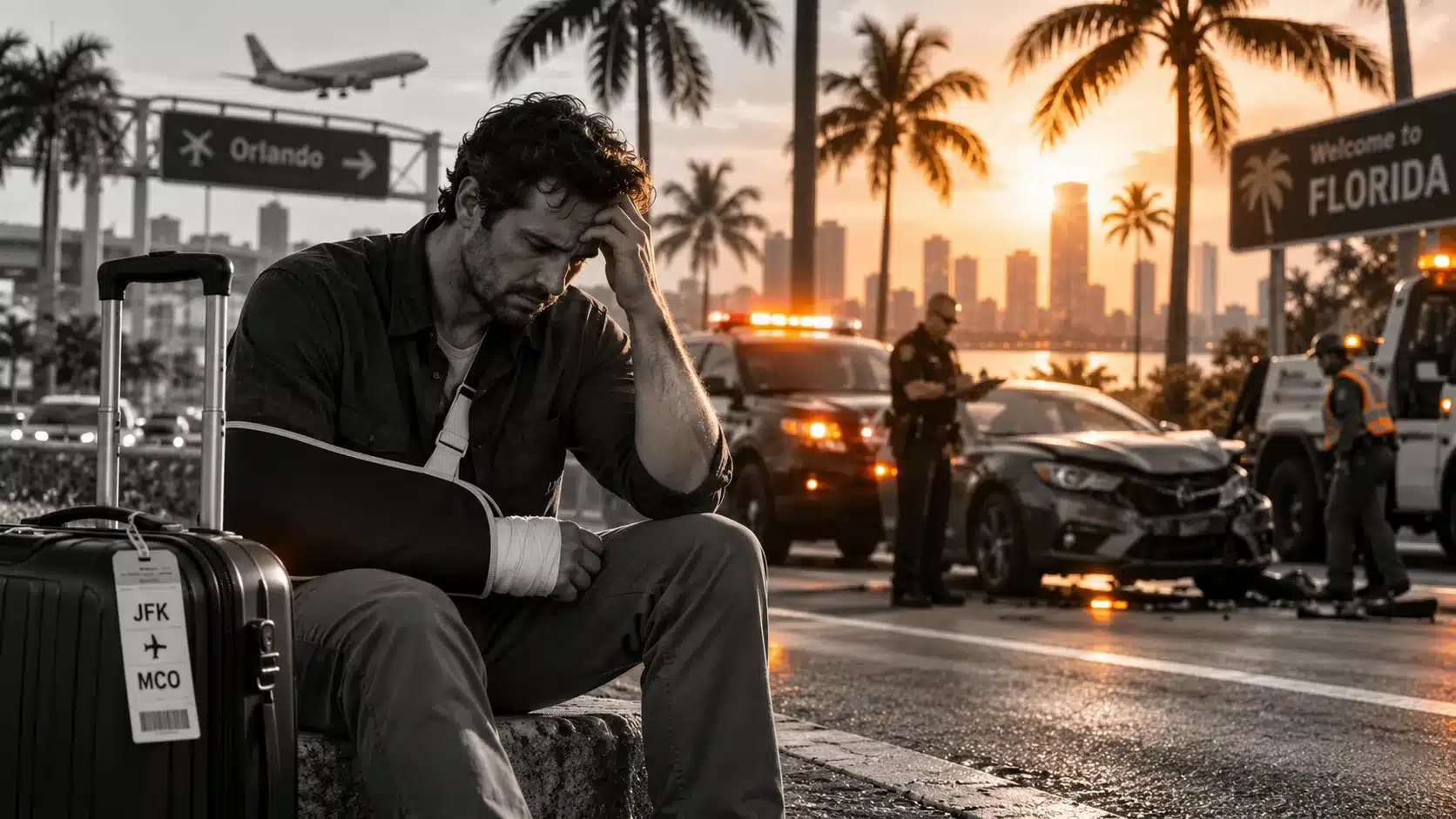

What Happens If You’re Injured in Florida, But Live in a Different State?
Living outside Florida does not prevent you from pursuing compensation if you were injured here. In many cases, Florida law will govern key parts of the claim, including fault, negligence, damages, and filing deadlines. Insurance can be more complicated, though, especially if your own policy was issued in another state and follows different coverage rules.
You also do not have to remain in Florida throughout the claim. Many injured visitors receive their initial care here, return home, continue treatment with local doctors, and work with a Florida attorney remotely.
What matters most is dealing with the accident before distance makes the evidence harder to recover.
A hotel surveillance video can be erased. Witnesses can become difficult to locate. A damaged rental vehicle may be repaired or sold. Those problems are much easier to address while the evidence still exists.
Can a Tourist or Out-of-State Visitor File an Injury Claim in Florida?
Yes, you do not have to become a Florida resident, own property here, or remain in the state after the accident to pursue a claim arising from an injury that occurred in Florida.
An out-of-state visitor may have a claim after a:
- Car or truck crash
- Rideshare accident
- Motorcycle collision
- Pedestrian or bicycle crash
- Slip and fall
- Hotel or resort accident
- Theme park injury
- Boating accident
- Vacation rental accident
- Injury at a restaurant, store, or other business
Florida’s long-arm statute generally allows Florida courts to exercise jurisdiction over a person or business for a claim arising from certain Florida-based conduct, including committing a tortious act in the state. Whether a particular defendant can be sued in Florida can also depend on constitutional due-process requirements and the specific facts. Florida law provides a specific method for service of process on nonresident owners and operators in civil actions arising from Florida motor-vehicle accidents.
Living in Ohio, New York, Texas, Massachusetts, or another state does not erase a claim simply because you went home.
Iva_ 1313
(Translated by Google) Overall, I would recommend RTRLaw to anyone who needs a car accident attorney. They are trustworthy, professional, and very committed to their clients. (Original) En general, recomendaría a RTRLaw a cualquiera que necesite un abogado especializado en accidentes de carro. Son confiables, profesionales y muy comprometidos con sus clientes.
Does Florida Law Apply Because the Accident Happened Here?
Often, but not necessarily to every issue in the case; a Florida auto accident creates a strong connection to Florida law. Florida traffic laws, premises-liability rules, comparative fault principles, and Florida filing deadlines may apply to the injury claim.
Insurance can be less straightforward.
Suppose a Michigan resident drives to Florida and is struck by a Florida driver. The collision happened in Florida, but the Michigan driver’s own insurance policy was written and issued in Michigan.
The negligence claim against the other driver and the contract rights under the Michigan insurance policy are not necessarily governed by the same rules.
The answer may depend on:
- Where the accident occurred
- Where the parties live
- Where the insurance policy was issued
- Which vehicle was involved
- Where that vehicle is registered or principally kept
- The wording of the policy
- What type of benefit is being claimed
That is why interstate accident claims should be analyzed policy by policy rather than reduced to “Florida law applies to everything.”
What Happens With Auto Insurance After a Florida Crash?
This is where many out-of-state drivers become confused; Florida has a no-fault auto insurance system that requires qualifying Florida policies to provide Personal Injury Protection benefits. Florida PIP can provide up to $10,000 in medical and disability benefits, subject to statutory limitations. To qualify for medical benefits, an injured person generally must receive qualifying initial services and care within 14 days after the crash. Without a qualifying determination of an emergency medical condition, medical benefits may be limited to $2,500.
That does not mean every tourist automatically receives Florida PIP. Coverage can depend on the vehicle involved, the policy insuring it, the injured person’s status, and whether another applicable policy provides benefits first.”
An out-of-state driver’s available coverage may instead involve some combination of:
- Their own state’s no-fault or PIP benefits
- Medical payments coverage
- The policy covering the vehicle they were occupying
- Any bodily-injury liability coverage available under the at-fault driver’s policy
- Uninsured or underinsured motorist coverage
- Health insurance
- Rental car coverage
- Rideshare coverage
A visitor should report the collision to the appropriate insurer promptly, but reporting the accident and giving a detailed recorded statement are not the same thing.
Before giving a broad statement about injuries, fault, speed, or medical history to another driver’s insurance company, it may be wise to understand which insurer you are dealing with and what it is trying to determine.
Can You Go Home and Continue Medical Treatment There?
Yes, someone injured on vacation does not normally need to spend the next several months traveling back to Florida for routine medical care.
A person might go to a Florida emergency room after the crash, then continue treatment with an orthopedic surgeon, neurologist, physical therapist, or other provider near home.
The medical records should tell a consistent story.
Before leaving Florida, keep copies of whatever is available:
- Hospital discharge paperwork
- Imaging reports
- Prescriptions
- Referral instructions
- Accident or incident report information
When you begin treating at home, tell the new provider when the Florida accident occurred, how the injury happened, what symptoms began afterward, and what treatment you already received.
Long unexplained gaps can create problems. Insurers often use them to argue that the injury improved, that later treatment was unnecessary, or that something else caused the symptoms.
If you are still hurting, do not let a plane ticket become the last entry in your medical record.
What Evidence Should You Collect Before Leaving Florida?
Distance changes an injury claim; once you are hundreds or thousands of miles away, going back to photograph a broken handrail or locate a hotel employee becomes much harder.
If your health allows it, try to preserve the basics before leaving:
- Photographs and video of the scene
- Photographs of visible injuries
- Witness contact information
- The crash or incident report number
- Insurance information
- Receipts, tickets, reservations, or rental agreements
- Damaged clothing or personal items
- Vehicle photographs
- Names of the business employees who responded
For an accident at a hotel, store, resort, restaurant, or other property, surveillance footage can be especially valuable.
Do not assume the business will save it indefinitely. A preservation request sent soon after the incident may become far more useful than trying to find the footage months later.
What If Everyone Involved Lives Outside Florida?
The claim does not necessarily move elsewhere just because everyone was visiting.
Florida law specifically provides a method for serving a nonresident vehicle owner or operator in a civil action arising from an accident or collision in Florida.
Imagine that a Massachusetts family is driving through Orlando and is hit by a tourist from Texas.
Neither driver lives in Florida, but the crash happened on a Florida roadway. Florida still has a substantial connection to the accident, the investigation, local witnesses, and the conduct that caused the collision.
The exact court and venue depend on the parties and facts, but being from another state does not make a Florida accident legally untouchable.
What if You Were Partly at Fault?
Florida’s modified comparative fault law can affect an out-of-state visitor just as it can a Florida resident.
Under Florida Statute 768.81, damages in many negligence cases are reduced according to the injured person’s percentage of fault. A claimant found more than 50% responsible for their own harm generally cannot recover in an ordinary negligence action covered by that rule.
Suppose your damages are $100,000 and you are found 20% responsible. A comparative-fault reduction could reduce the recovery to $80,000.
That becomes important when an insurer argues that a visitor was:
- Speeding
- Distracted
- Following too closely
- Ignoring a warning
- Not watching where they were walking
- Entering an area that was closed to the public
Fault should be decided from evidence, not from an adjuster’s early assumption.
How Long Do You Have to File a Florida Injury Lawsuit?
Florida generally gives a person two years to file an action founded on negligence. Wrongful death claims also generally have a two-year limitations period. Different claims can have different deadlines, and exceptions may change the analysis.
Do not assume the deadline from your home state controls because that is where you live.
Claims against government entities can also involve presuit requirements in addition to the normal lawsuit deadline. Insurance policies may impose separate notice duties.
There is another practical deadline that receives less attention: the life of the evidence.
A statute may give you years to file a lawsuit while a security camera keeps footage for only days or weeks. Waiting can damage a claim long before the legal deadline arrives.
Do You Have to Travel Back to Florida for the Case?
Not for every step; a large portion of an injury claim can often be handled while you are at home. Medical records can be collected electronically. Attorney meetings can take place by video or phone. Insurance negotiations do not require you to sit in a Florida office.
If litigation becomes necessary, there may be proceedings that require more involvement. Depending on the case, those can include a deposition, medical examination, mediation, hearing, or trial.
Some may be handled remotely. Others may require travel.
That possibility should not be confused with having to repeatedly fly back to Florida throughout the entire claim.
What Can an Out-of-State Visitor Recover?
A Florida injury claim does not stop counting losses when you cross the state line; depending on the case, recoverable damages may include medical treatment received in Florida and treatment received after returning home.
Other damages may include:
- Future medical care
- Lost income
- Reduced earning capacity
- Property damage
- Rehabilitation expenses
- Pain and suffering when legally available
- Scarring
- Disability
- Other accident-related financial losses
Travel disruptions may also create documented expenses. A serious injury can require an extra hotel stay, a changed flight, transportation assistance, or other costs that would not have existed without the accident.
Keep the receipts.
Frequently Asked Questions
Can I hire a Florida personal injury lawyer if I live somewhere else?
Yes. A Florida injury attorney can represent an out-of-state client in a Florida injury matter. Much of the attorney-client communication can be handled remotely.
Can I treat with my regular doctor when I get home?
Usually, yes. Make sure the doctor understands that the symptoms followed the Florida accident and has any useful records from the treatment you received here.
Does Florida PIP automatically cover a tourist?
No. Florida PIP applies according to the statute and the insurance policies involved. An out-of-state visitor may have coverage through a policy issued in another state instead.
What if I was injured at a Florida hotel or theme park?
Your residence does not prevent you from pursuing a premises-liability claim. Report the incident and preserve photographs, witness information, receipts, and other evidence before leaving whenever possible.
Can I wait until I get home to contact a lawyer?
You can, but waiting may make local evidence harder to preserve. Serious accidents involving surveillance video, unsafe property conditions, commercial vehicles, or disputed fault benefit from early investigation.
A Florida Injury Does Not End When Your Trip Does
Getting hurt away from home creates problems that local accident victims do not have.
You may be trying to arrange medical care in two states while dealing with a rental car company, an insurer you have never heard of, missed travel plans, and evidence sitting hundreds of miles away.
Handle what you can before leaving. Document the scene. Get medical care. Save the paperwork. Once home, keep treating if your injuries require it.
RTRLAW has represented injury victims since 1988. If you were injured while visiting Florida, our attorneys can investigate the accident here while you recover at home.
Call 1-833-HIRE-RTR for a free, no-obligation case review. Qualifying personal injury cases are handled on a No Win, No Fee basis.