


Texas’s 51% Bar Rule: What Happens to Your Car Accident Claim When You’re Partly at Fault
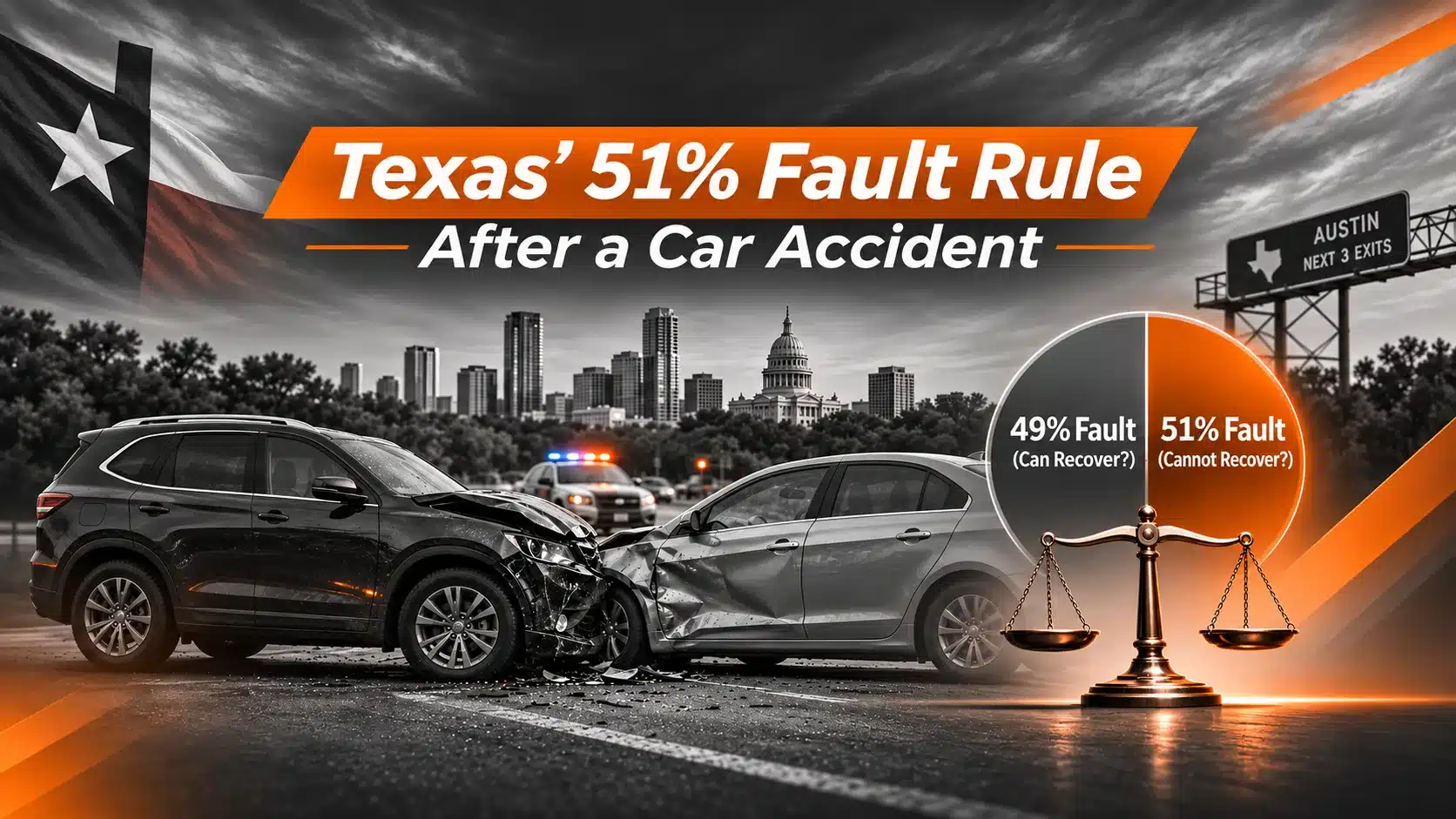
You may still be able to recover compensation after a Texas car accident even if you share some of the blame. Under Texas Civil Practice and Remedies Code §33.001, an injured person who is 50% or less responsible can generally recover damages, but the amount is reduced based on that percentage of fault. If your share of responsibility rises above 50%, Texas law generally bars you from recovering from the other responsible parties.
That cutoff is why Texas’s proportionate-responsibility system is often called the 51% bar rule. A difference of only one percentage point can have a major effect: someone found 50% responsible may still recover half of their damages, while someone found 51% responsible may recover nothing.
Fault percentages are also frequently disputed long before a case reaches a courtroom. Insurance companies may argue that an injured driver contributed to the crash in an effort to reduce what they are willing to pay, making evidence such as dashcam footage, the Texas Peace Officer’s Crash Report, photographs, witnesses, and vehicle data especially important.
How Does Texas’s 51% Bar Rule Work?
Texas uses a system called proportionate responsibility to divide fault when more than one person contributed to an accident. The person bringing the claim is not barred simply because they made a mistake or contributed in some way to the collision.
Texas Civil Practice and Remedies Code §33.001 sets the cutoff: a claimant may not recover damages when that person’s percentage of responsibility is greater than 50%. Section 33.012 then requires the court to reduce an eligible claimant’s damages according to the percentage of responsibility assigned to that claimant.
The basic rule looks like this:
| Your Share of Fault | What Generally Happens |
| 0% | No comparative-fault reduction |
| 20% | Recovery reduced by 20% |
| 50% | Recovery reduced by 50% |
| 51% | Recovery generally barred |
| 75% | Recovery generally barred |
The important line is therefore not whether you share any fault. It is whether your assigned responsibility exceeds 50%.
Rose V
Matthew Lewis was a great attorney and helped me with setting up everything I needed. Was extremely insightful and gave me all the advice I needed.
What Happens if You Are 20% at Fault for a Texas Car Accident?
If you are found 20% responsible for an auto accident in Texas, you may generally recover 80% of your proven damages.
Assume your total damages are $100,000. Those damages could include qualifying medical expenses, lost income, future losses, pain and suffering, or other legally recoverable damages.
If you are assigned 20% responsibility:
- $100,000 × 20% = $20,000 reduction
That leaves a potential recovery of:
- $80,000
This is exactly how §33.012 operates when the claimant is not barred under the greater-than-50% rule: the damages are reduced by the claimant’s own percentage of responsibility.
A 20% allocation can still mean losing a significant amount of money, which is why seemingly small disputes over fault deserve attention.
What Happens if You Are Exactly 50% at Fault?
A Texas claimant who is exactly 50% responsible is not automatically barred from recovery. The statute bars recovery only when responsibility is greater than 50%.
Using the same $100,000 example:
- $100,000 × 50% = $50,000 reduction
Potential recovery:
- $50,000
This is one of the most important details of the Texas rule. People sometimes hear “51% bar” and assume they must be less than 50% responsible. That is not what §33.001 says.
At exactly 50%, recovery may still be available, subject to the other facts and legal issues in the case.
What Happens if You Are 51% at Fault?
At 51% responsibility, the result changes dramatically.
Texas Civil Practice and Remedies Code §33.001 generally prevents a claimant from recovering damages once the claimant’s responsibility exceeds 50%.
Using a $100,000 damages figure:
- 50% fault → potentially $50,000
- 51% fault → generally $0
That one-percentage-point difference explains why fault allocation can become one of the most heavily contested parts of a Texas car accident claim.
The parties are not simply arguing about who caused the crash in a general sense. They may be arguing about whether the injured driver’s conduct places the claim above or below a legal cutoff.
Who Actually Determines the Percentage of Fault in Texas?
If a Texas car accident case is litigated and responsibility must be formally decided, the trier of fact determines the percentage of responsibility assigned to the claimant, defendants, settling persons, and designated responsible third parties when supported by sufficient evidence.
Texas Civil Practice and Remedies Code §33.003 requires those percentages to be stated in whole numbers. It also says a person’s conduct cannot be submitted for a responsibility finding without sufficient evidence supporting that submission.
Before trial, however, insurance companies routinely make their own assessments of fault when evaluating claims and settlement offers.
Those insurance-company percentages are not the same thing as a final court determination.
An adjuster might say:
- We believe our driver was 60% responsible and you were 40% responsible.
That can affect the insurer’s settlement position, but it does not automatically establish that you are legally 40% at fault.
The evidence can support a different allocation.
How Do Insurance Companies Use Fault Percentages to Reduce Settlement Offers?
An insurance company can reduce its settlement position by arguing that the injured driver contributed to the collision. The larger the percentage assigned to you, the less the insurer may offer.
Suppose your damages are valued at $150,000.
An insurer arguing that you were 30% responsible may begin from an adjusted figure of approximately:
- $150,000 − 30% = $105,000
If it argues that you were 50% responsible, that figure falls to:
- $75,000
And if the insurer takes the position that you were 51% or more responsible, it may deny liability altogether based on Texas’s proportionate-responsibility rule.
Common allegations include that the injured driver:
- Was speeding
- Followed too closely
- Changed lanes unsafely
- Failed to keep a proper lookout
- Entered an intersection too quickly
- Was distracted
- Failed to brake or take evasive action
- Contributed to a merge collision
An insurer’s assertion is not proof. The question is whether the available evidence actually supports the percentage being claimed.
What Evidence Can Change the Fault Percentage After a Texas Crash?
Fault percentages are built from evidence, so new or better evidence can substantially change how a collision is evaluated. A case that initially looks like shared fault may look very different after video, witnesses, or vehicle data are reviewed.
Dashcam and Video Footage
Dashcam footage can be particularly valuable because it may show events that happened seconds before impact.
Video might establish:
- Which vehicle entered a lane first
- Whether a traffic signal was red or green
- How quickly traffic was moving
- Whether someone cut across several lanes
- Whether a driver was forced to take evasive action
Nearby businesses, homes, traffic systems, or other motorists may also have useful footage.
Video should be preserved quickly because many systems automatically overwrite old recordings.
The Texas Peace Officer’s Crash Report, or CR-3
The CR-3 is the Texas Peace Officer’s Crash Report used by law enforcement to document reportable crashes. TxDOT maintains these reports through its Crash Records Information System and makes them available to people authorized by Texas law.
A CR-3 may contain information about:
- Drivers and vehicles
- Crash location
- Road and weather conditions
- Injuries
- Vehicle movements
- Contributing factors
- A crash diagram
The crash report can be useful, but it should not be treated as the final word on civil fault. The investigating officer may not have witnessed the collision, and additional evidence can change how responsibility is evaluated.
TxDOT is also only the custodian of the crash report itself. Dashcam video, scene photographs, field notes, and similar materials generally must be requested from the investigating law-enforcement agency.
Independent Witnesses
A neutral witness can become especially important when both drivers tell different stories.
A witness may have seen:
- Which driver entered the intersection first
- Whether a vehicle changed lanes
- Whether someone appeared to be speeding
- Whether a turn signal was used
- What happened immediately before the impact
Get witness contact information at the scene when possible. Finding the same person months later can be much harder.
Vehicle and Physical Evidence
The vehicles themselves can also tell part of the story.
Useful evidence may include:
- Damage location
- Debris
- Skid or tire marks
- Vehicle Event Data Recorder information
- Photographs showing final resting positions
- Electronic data from commercial vehicles
- Cellphone records when distraction is disputed
No single piece of evidence necessarily determines the percentages. The strongest fault analysis often comes from comparing several independent sources.
Can Someone Else Share Fault Besides the Two Drivers?
Yes. Texas proportionate-responsibility law can allocate responsibility to more than just the two motorists directly involved in the collision.
Under §33.003, a trier of fact may assign percentages of responsibility among the claimant, defendants, settling persons, and properly designated responsible third parties when supported by the evidence.
Depending on the crash, that could become relevant when another person or company contributed to the harm.
For example, a commercial crash could raise questions about the trucking company in addition to the truck driver. A multi-vehicle collision may involve several drivers whose actions contributed to the sequence of impacts.
This is another reason fault percentages should not be evaluated too quickly from the first description of the crash.
What Should You Do if an Insurance Company Says You Were Partly at Fault?
Do not assume the percentage assigned by the insurance company is final. Ask what evidence supports that position and preserve evidence that may show a different version of the crash.
After a disputed-fault Texas collision:
- Obtain the CR-3 crash report when available.
- Save dashcam footage immediately.
- Photograph vehicle damage and the accident location.
- Obtain witness information.
- Preserve texts, photographs, or other time-stamped information relevant to the crash.
- Avoid guessing about your speed or fault in recorded statements.
- Keep records of your injuries and damages.
- Consider having the accident investigated before important evidence disappears.
The difference between 20%, 50%, and 51% responsibility can be substantial. Evidence that shifts even a small percentage of fault can therefore change the value or viability of a claim.
Frequently Asked Questions About Texas’s 51% Bar Rule
Can I recover compensation if I was partly at fault for a Texas car accident?
Yes. Texas generally allows recovery when you are 50% or less responsible, although your damages are reduced by your percentage of fault.
Can I recover if I am exactly 50% responsible?
Potentially, yes. Section 33.001 bars recovery only when your responsibility is greater than 50%.
What happens at 51% fault in Texas?
A claimant found 51% responsible is generally barred from recovering damages under Texas’s proportionate-responsibility statute.
Does the police report decide who is at fault?
Not by itself. The CR-3 can provide important information about the collision, but the formal percentage of responsibility in litigation is determined under Texas’s proportionate-responsibility rules based on the evidence.
Can an insurance company change its fault determination?
Yes. An insurer’s pre-lawsuit liability assessment can change when additional evidence becomes available. Video, witnesses, photographs, crash reconstruction, or other evidence may support a different allocation.
Do Not Assume an Insurance Company’s Fault Percentage Is the Final Answer
Being partly responsible for a Texas car accident does not necessarily end your claim. Texas law allows an injured person who is 50% or less responsible to potentially recover damages, with the award reduced according to that person’s share of responsibility. Cross the line to 51%, however, and recovery may be barred.
That makes fault evidence more than a technical issue. A dashcam video, independent witness, CR-3 report, or physical evidence showing how the crash occurred can affect both the percentage assigned to you and the amount you may ultimately recover.
RTRLAW has represented motor vehicle accident victims since 1988. If an insurance company is blaming you for part or all of a Texas car accident, our Texas personal injury attorneys can investigate the collision, examine the available evidence, and challenge fault allegations that are not supported by the facts.
Call 1-833-HIRE-RTR for a free, no-obligation case review. Qualifying personal injury cases are handled on a No Win, No Fee basis.