



Are All Driving Laws in the United States the Same?
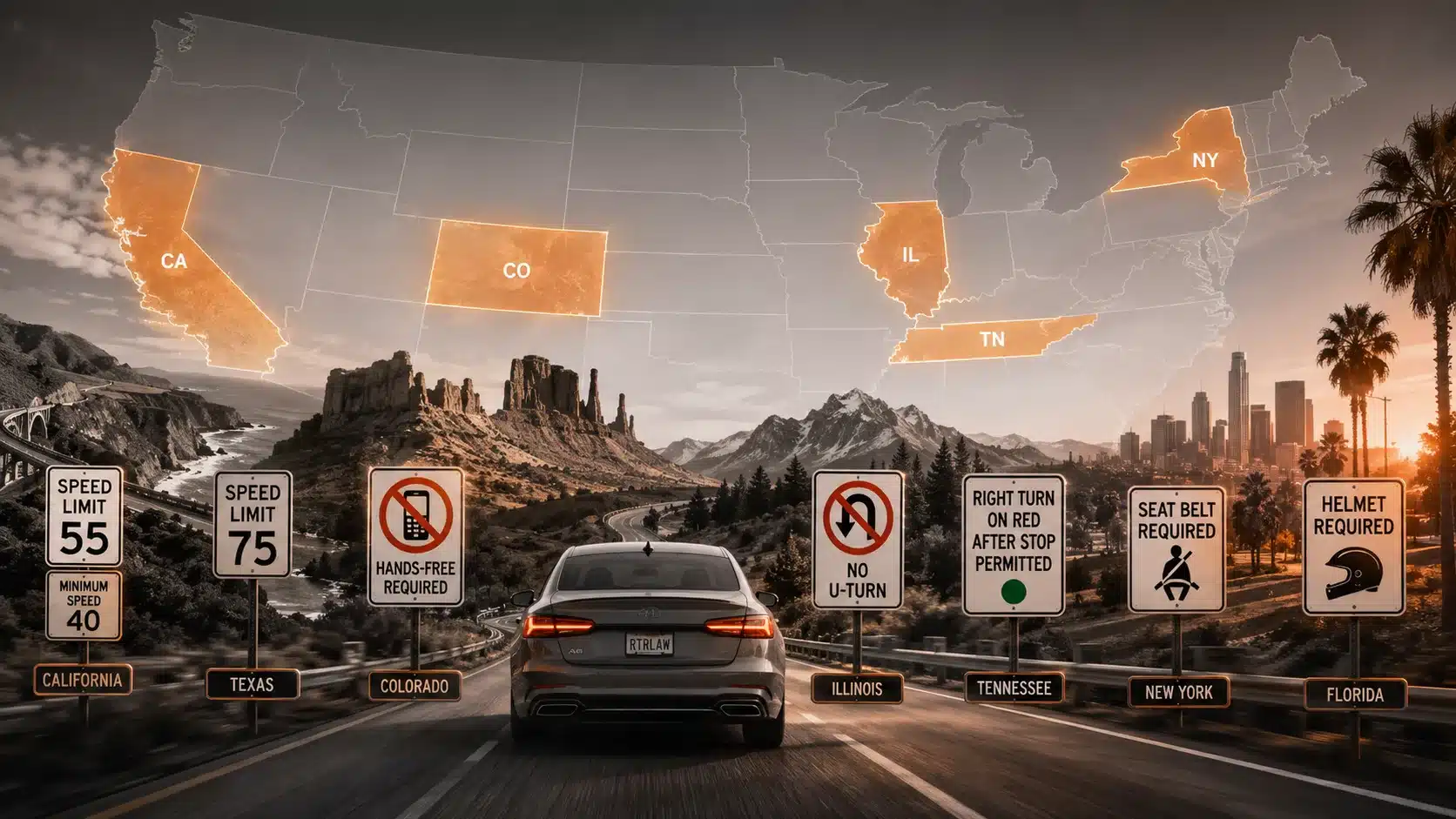
While the basic rules of the road may seem familiar from one state to another, driving laws are not uniform across the United States. Each state establishes its own requirements for issues such as cellphone use, speed limits, seat belts, insurance coverage, impaired driving, and liability after an accident, which means conduct that is legal in one state may be restricted or prohibited in another.
The differences can affect:
- Speed limits
- Cellphone use
- Seat belt enforcement
- Motorcycle helmet requirements
- Teen driver restrictions
- Vehicle inspections
- Minimum insurance coverage
- No-fault benefits
- Comparative negligence
- Accident-reporting requirements
- Deadlines for filing injury lawsuits
- Penalties for traffic violations
Federal law creates national standards in certain areas, including vehicle manufacturing, commercial trucking, commercial driver licensing, and traffic-control devices. However, state legislatures enacts most everyday driving rules and may be supplemented by county or city ordinances. The Federal Highway Administration requires states to adopt traffic-control standards substantially conforming to the national Manual on Uniform Traffic Control Devices, which explains why stop signs, traffic lights, lane markings, and many road signs look similar across the country.
The differences become especially important after a car accident. A driver who crosses a state line may face different insurance requirements, fault rules, coverage systems, and legal deadlines without realizing anything has changed.
RTRLAW has represented auto accident victims since 1988. Our attorneys understand that determining what law applies after a crash is not always as simple as looking at the state on a driver’s license or the license plate on the vehicle.
Why Do Driving Laws Differ From State to State?
The United States does not have one comprehensive national traffic code governing every private driver on every public road. States traditionally regulate driver licensing, vehicle registration, traffic offenses, insurance requirements, and civil liability for crashes occurring within their borders.
State lawmakers may respond differently to the same safety concern based on:
- Population density
- Road design
- Weather conditions
- Rural driving needs
- Public transportation availability
- Traffic-fatality data
- Insurance-market conditions
- Legislative priorities
- Local law-enforcement practices
- Public opinion
A rural state with long stretches of open highway may adopt different speed laws than a densely populated state with older roads and crowded urban centers. A state experiencing a rise in distracted-driving deaths may enact a broad hands-free law, while another may prohibit texting but still allow drivers to hold phones for voice calls.
Cities and counties may sometimes impose additional restrictions when state law allows local regulation. Texas, for example, prohibits electronic messaging while driving statewide, but the Texas Department of Transportation warns that some cities have broader cellphone ordinances.
Drivers should therefore treat the law of the state, and sometimes the specific city, where they are driving as controlling.
Mathi C
Excellent service. They guided me through the whole process. Professional, transparent and insightful.
What Driving Rules Are Generally Similar Across the Country?
Many basic road rules appear consistent because states have adopted similar traffic codes and national standards influence how roads, vehicles, and commercial transportation are regulated.
Common rules generally require drivers to:
- Obey traffic lights and road signs
- Stop at stop signs
- Yield when legally required
- Remain within marked lanes
- Signal before turning or changing lanes
- Avoid following another vehicle too closely
- Stop after a crash
- Exchange identifying and insurance information
- Render reasonable assistance after an injury crash
- Avoid reckless or impaired driving
- Use appropriate child restraints
- Carry a valid driver’s license
- Maintain required vehicle registration and insurance
Traffic signs and signals are also relatively uniform. The federal Manual on Uniform Traffic Control Devices establishes nationwide standards for signs, pavement markings, traffic signals, and other devices used on roads open to public travel. States must adopt the national manual, adopt it with a conforming supplement, or maintain a state manual that substantially conforms to it.
Uniform appearance does not mean every underlying law is identical. A familiar sign may carry different fines, enforcement methods, license consequences, or civil effects depending on where the violation occurs.
Does Federal Law Control Any Driving Rules?
Federal law plays an important role, but it does not replace state traffic law for ordinary motorists.
The federal government regulates areas such as:
- Vehicle manufacturing and equipment safety
- Airbags, brakes, tires, lighting, and crashworthiness
- Commercial trucking and bus operations
- Commercial driver licensing standards
- Interstate motor-carrier safety
- Hazardous-material transportation
- Maximum hours of service for many commercial drivers
- National traffic-control-device standards
- Vehicle recalls and defect investigations
Vehicles sold in the United States must be certified by their manufacturers as complying with applicable Federal Motor Vehicle Safety Standards.
Commercial drivers are also subject to substantial federal regulation. The Federal Motor Carrier Safety Administration establishes minimum standards for commercial driver licensing and regulates many interstate trucking and passenger-carrier operations. States issue commercial driver’s licenses and may impose additional restrictions consistent with federal requirements.
For ordinary private drivers, however, state law continues to control most questions involving speeding, cellphone use, insurance, fault, licensing, and traffic citations.
Are Drunk-Driving Laws the Same in Every State?
Every state prohibits impaired driving, but the exact terminology, procedures, and penalties differ.
States use different names for impaired-driving offenses, including:
- DUI, or driving under the influence
- DWI, or driving while intoxicated or impaired
- OUI, or operating under the influence
- OWI, or operating while intoxicated
For adult noncommercial drivers, every state except Utah uses a blood alcohol concentration of 0.08 as the illegal per se limit. Utah uses a lower 0.05 limit. A driver may still be arrested or convicted with a lower reading when other evidence shows impairment.
The states may differ substantially in:
- Mandatory jail sentences
- License-suspension periods
- Ignition-interlock requirements
- Treatment and education programs
- Vehicle impoundment
- Enhanced penalties for high BAC levels
- Chemical-test refusal consequences
- Rules governing marijuana and other drugs
- Lookback periods for prior convictions
- Treatment of an offense as a misdemeanor or felony
Texas refers to the offense as DWI and considers a person legally intoxicated at 0.08, although a driver may violate the law whenever alcohol or drugs affect the ability to drive safely. Massachusetts commonly uses OUI, while Michigan uses OWI and imposes enhanced consequences for a high BAC of 0.17 or more.
Drivers should never assume that the penalties they understand in their home state will be the same elsewhere.
Do Cellphone and Texting Laws Differ by State?
Yes. Distracted-driving laws are among the clearest examples of state-by-state differences.
Some states prohibit nearly all handheld cellphone use while driving. Others prohibit texting and electronic messaging but allow certain handheld voice calls. Additional restrictions may apply to school zones, work zones, commercial drivers, school bus drivers, or drivers under a specified age.
| State | General Cellphone Rule |
| Florida | Drivers may not manually type, send, or read nonvoice electronic communications while operating a vehicle; handheld use is additionally restricted in designated school and work zones |
| Texas | Electronic messaging while driving is prohibited statewide; some municipalities impose broader cellphone restrictions |
| Massachusetts | Drivers may not hold a mobile electronic device and generally may use one only in hands-free mode |
| Michigan | Drivers generally may not hold or manually use a mobile electronic device while operating a motor vehicle |
Florida’s statute prohibits manually typing, sending, or reading text-based communications while operating a vehicle. A stationary vehicle is generally excluded from that prohibition, and the law contains exceptions for navigation, safety alerts, emergencies, and certain voice-operated functions. Florida separately restricts handheld device use in school and work zones.
Texas prohibits reading, writing, or sending electronic messages while driving. Texas also imposes additional restrictions on young drivers, school bus drivers, and handheld use in school zones, while some cities regulate cellphone use more broadly.
Massachusetts has a broader hands-free law. A driver may not hold a mobile electronic device or use one unless it is being operated in hands-free mode, subject to limited exceptions.
Michigan similarly prohibits drivers from holding or manually using mobile electronic devices while operating a motor vehicle, including while temporarily stopped for traffic, a light, or a stop sign.
Because the rules change at state and sometimes city boundaries, the safest approach is to mount the phone, program navigation before moving, and avoid touching the device until the vehicle is lawfully parked.
Are Speed Limits the Same Across the United States?
No. Speed limits vary by state, road type, municipality, and road conditions.
A state may establish different maximum or default limits for:
- Interstate highways
- Divided highways
- Residential streets
- Business districts
- School zones
- Construction zones
- Rural roads
- Unpaved roads
- Trucks or vehicles towing trailers
Even within one state, a city or transportation agency may lower a speed limit based on traffic studies, pedestrian activity, road design, or crash history.
A posted speed limit is also not always permission to travel at that exact speed under every condition. Drivers are generally expected to reduce speed when rain, snow, fog, congestion, construction, pedestrians, or other hazards make the posted limit unsafe.
This means a driver may be negligent after a crash even without receiving a speeding ticket. Traveling too fast for the conditions can be dangerous even when the speedometer was below the number on the sign.
Are Seat Belt Laws Enforced the Same Way Everywhere?
No. Every state has occupant-restraint laws, but the people covered, exceptions, fines, and enforcement procedures vary.
A primary-enforcement law allows an officer to stop a vehicle after observing a qualifying seat belt violation. Under secondary enforcement, an officer generally needs another lawful reason for the stop before issuing the seat belt citation.
NHTSA confirms that state seat belt laws vary in whom they cover and whether enforcement is primary or secondary. Some states apply primary enforcement to drivers and front-seat passengers but use different rules for rear-seat passengers.
States also differ regarding:
- Whether rear-seat adults must buckle up
- Which occupant receives the ticket
- The age at which child-restraint law ends and seat belt law begins
- Medical exemptions
- Older vehicles without factory-installed belts
- Whether nonuse can be mentioned in an injury lawsuit
- Whether seat belt evidence may reduce damages
Massachusetts requires qualifying occupants to wear properly adjusted safety belts but generally treats an adult violation differently from states with broader primary-enforcement laws.
Regardless of enforcement differences, every occupant should buckle up every time the vehicle moves.
Do Child Car Seat Requirements Change Across State Lines?
Yes. Every state requires child restraints, but the age, height, weight, seat type, and rear-facing requirements differ.
One state may require a booster seat until a child reaches a particular age. Another may use both age and height. Some states expressly require children to remain rear-facing until a specified age, while others rely more heavily on the restraint manufacturer’s limits.
Differences may involve:
- Rear-facing car seats
- Forward-facing harnesses
- Booster seats
- Height and weight thresholds
- Front-seat restrictions
- School bus exceptions
- Rideshare or taxi exceptions
- Responsibility of the driver versus the parent
- Penalties and driver-license points
Parents traveling interstate should follow the law of the state through which they are driving while also observing the safety instructions for the specific restraint. The safest practice may be more protective than the minimum legal requirement.
Are Motorcycle Helmet Laws the Same?
No. Motorcycle helmet laws differ considerably.
Some states require helmets for nearly every rider. Others impose age-based requirements or allow certain adults to ride without helmets if they carry specified insurance coverage.
Florida, for example, provides a limited helmet exception for qualifying riders over age 21 who carry the required medical insurance coverage. Florida officials caution that ordinary PIP coverage under a passenger-vehicle policy is not sufficient proof for the motorcycle helmet exception.
Other motorcycle rules that may vary include:
- Eye-protection requirements
- Passenger age
- Required footrests and handholds
- Lane splitting
- Handlebar height
- Headlight use
- Motorcycle endorsements
- Insurance requirements
- Noise limits
A rider who is legal in one state may violate the law shortly after crossing into another.
Do States Require the Same Auto Insurance?
No. Auto insurance laws are significantly different across the United States.
States may require:
- Bodily injury liability
- Property damage liability
- Personal Injury Protection
- Medical payments coverage
- Uninsured motorist coverage
- Underinsured motorist coverage
- Property protection insurance
- Proof of financial responsibility
The minimum required amounts also differ. More importantly, some states use a traditional fault-based liability system, while others require no-fault benefits that initially pay certain expenses without regard to who caused the collision.
| State | Basic Insurance Structure |
| Florida | No-fault system requiring Personal Injury Protection and property damage liability for most registered vehicles |
| Texas | Fault-based system requiring minimum liability coverage commonly described as 30/60/25 |
| Massachusetts | No-fault system with four compulsory coverages, including Personal Injury Protection |
| Michigan | No-fault system requiring Personal Protection Insurance, property protection insurance, and residual liability coverage |
Florida generally requires at least $10,000 in PIP and $10,000 in property damage liability coverage for registered private vehicles. Bodily injury liability is not part of the standard minimum requirement for every Florida private driver, although it can become mandatory after certain crashes or violations.
Texas requires at least $30,000 in bodily injury liability for one injured person, $60,000 per crash, and $25,000 for property damage. Texas officials warn that these minimum limits may be insufficient after a serious or multi-vehicle crash.
Massachusetts requires four compulsory coverages. Its PIP coverage generally pays up to $8,000 in qualifying medical expenses and certain lost income without regard to fault, subject to policy rules and coordination with health insurance.
Michigan requires no-fault automobile insurance, including PIP benefits for allowable medical care, recovery, and rehabilitation after an auto accident. Michigan’s reformed no-fault system allows policyholders to choose among available PIP medical coverage levels when eligible.
A policy that satisfies one state’s minimum requirements may not provide the same protection a driver expects after an accident in another state.
What Is the Difference Between a Fault State and a No-Fault State?
The term “no-fault” usually refers to how certain initial injury-related expenses are paid. It does not mean that no one can ever be held responsible for causing a crash.
In a traditional fault-based system:
- The at-fault driver’s liability coverage generally pays the other party’s damages
- The insurer investigates negligence before accepting responsibility
- An injured person may pursue medical expenses, lost income, and other damages from the responsible party
- Optional medical payments or health insurance may pay some early bills
In a no-fault system:
- The injured person initially seeks certain benefits from the applicable PIP or no-fault insurer
- Those benefits may be available regardless of who caused the crash
- State law may restrict when an injured person can sue for pain and suffering
- Fault still matters for uncovered expenses, vehicle damage, serious injuries, and liability claims
Florida, Massachusetts, and Michigan all use forms of no-fault insurance, but the systems are not identical.
Florida PIP generally pays a portion of qualifying medical expenses and lost wages, while Florida law limits pain-and-suffering recovery to injuries meeting a statutory threshold, including permanent injury, significant permanent scarring or disfigurement, significant permanent loss of an important bodily function, or death.
A driver should not assume that experience with one no-fault state explains how another state’s system works.
Do Fault Rules After an Accident Differ by State?
Yes. States use different systems for assigning civil responsibility when more than one person contributed to a collision.
The primary systems are:
- Pure comparative negligence
- Modified comparative negligence with a 50-percent threshold
- Modified comparative negligence with a 51-percent threshold
- Contributory negligence
Under comparative negligence, compensation is generally reduced by the injured person’s percentage of responsibility. However, the threshold for losing the right to recover varies.
For example, a driver with $100,000 in damages who is found 20 percent responsible may recover $80,000 in a comparative-fault state. The result changes if that driver is found primarily responsible and the state has a recovery cutoff.
A small number of jurisdictions still follow contributory-negligence rules, which may bar recovery when the injured person bears even a small share of responsibility. That is one of the most significant differences a driver may encounter after crossing a state line.
How Do Florida, Texas, Massachusetts, and Michigan Compare After a Crash?
The following table summarizes several major differences affecting personal injury claims:
| State | Shared-Fault Rule | General Injury Lawsuit Deadline | Insurance Structure |
| Florida | A person more than 50 percent at fault generally cannot recover in an ordinary negligence action | Generally 2 years | No-fault PIP system |
| Texas | A claimant more than 50 percent responsible cannot recover | Generally 2 years | Fault-based liability system |
| Massachusetts | A claimant may recover when their negligence is not greater than the combined negligence of the parties from whom recovery is sought | Generally 3 years | No-fault PIP system |
| Michigan | Economic damages are generally reduced by fault; a person more than 50 percent at fault is generally barred from noneconomic damages | Generally 3 years | No-fault automobile insurance system |
These are general rules. Claims involving minors, government vehicles, defective products, wrongful death, unidentified drivers, intentional conduct, or contractual claims may involve different deadlines and procedures.
Florida Driving and Accident Laws
Florida uses a no-fault insurance system. Most registered private vehicles must carry PIP and property damage liability coverage. PIP ordinarily provides limited benefits for qualifying medical expenses and lost income regardless of who caused the crash.
Florida also follows modified comparative negligence. Under Florida Statute 768.81, a person found more than 50 percent responsible for their own harm generally cannot recover damages in an ordinary negligence action. A person who is 50 percent or less responsible may recover an award reduced by that percentage.
Most Florida negligence actions must generally be filed within two years.
Other Florida rules travelers should recognize include:
- Texting, emailing, and similar manual communications are prohibited while driving
- Handheld wireless-device use is restricted in designated school and work zones
- PIP requirements apply to most registered four-wheeled vehicles
- Pain-and-suffering claims arising from covered motor vehicle accidents generally require a threshold injury
Florida law requires drivers to remain at the scene after crashes involving property damage, injury, or death
Florida drivers should not assume their required PIP coverage will compensate them fully after a serious accident. Medical expenses, lost income, and noneconomic damages can quickly exceed the benefits available under a minimum policy.
Texas Driving and Accident Laws
Texas primarily uses a fault-based insurance system. The driver who causes a crash may be responsible for the resulting injuries and property damage, subject to available insurance and Texas proportionate-responsibility rules.
Texas requires minimum liability limits of $30,000 for bodily injury to one person, $60,000 per crash, and $25,000 for property damage.
Texas bars recovery when a claimant’s percentage of responsibility is greater than 50 percent. A claimant who is 50 percent or less responsible may recover compensation reduced by the assigned percentage. Texas personal injury lawsuits generally must be filed within two years after the claim accrues.
Texas drivers should also be aware that:
- Reading, writing, or sending electronic messages while driving is prohibited statewide
- Municipal cellphone ordinances may be stricter
- School-zone cellphone rules are more restrictive
- Texas roadways may have speed limits that differ substantially from neighboring states
- Minimum liability coverage may not be enough for a serious accident
- UM/UIM and PIP coverage may provide important additional protection even though they operate differently from Florida PIP
A Texas crash claim generally focuses on proving fault from the beginning because the injured party does not ordinarily rely on a mandatory statewide no-fault PIP system.
Massachusetts Driving and Accident Laws
Massachusetts requires compulsory automobile insurance and uses a no-fault PIP system for initial qualifying medical expenses and lost income.
Massachusetts PIP generally provides up to $8,000 in benefits, subject to health-insurance coordination and other policy rules.
Massachusetts driving laws follow modified comparative negligence. An injured person may recover when their negligence is not greater than the combined negligence of the parties from whom recovery is sought. The damages are reduced in proportion to the injured person’s fault.
Personal injury actions in Massachusetts generally must be filed within three years.
Massachusetts drivers should also remember:
- Handheld cellphone use is broadly prohibited
- A device generally must be used hands-free
- Drivers may view navigation only when the device is properly mounted
- Adult seat belt enforcement differs from the law in many primary-enforcement states
- Massachusetts uses the term OUI for impaired-driving offenses
- Compulsory insurance contains several distinct required coverages
The combination of no-fault benefits, compulsory insurance, comparative negligence, and state-specific thresholds can make a Massachusetts accident claim considerably different from a Texas claim.
Michigan Driving and Accident Laws
Michigan has one of the country’s most distinctive no-fault automobile insurance systems.
Michigan requires owners and registrants of covered vehicles to maintain no-fault insurance that includes personal protection insurance, property protection insurance, and residual liability coverage. PIP may pay allowable medical, recovery, and rehabilitation expenses after an accident.
Michigan also applies comparative fault. Economic damages are generally reduced according to the injured person’s percentage of fault. A person who is more than 50 percent responsible is generally barred from recovering noneconomic damages such as pain and suffering.
The general Michigan limitations period for actions seeking damages for personal injury is three years.
Michigan drivers should be aware that:
- Holding or manually using a mobile electronic device while driving is generally prohibited
- The phone restriction generally applies while temporarily stopped in traffic
- No-fault PIP coverage options can affect available medical benefits
- Separate rules govern vehicle damage, residual liability, and serious-injury claims
- Michigan uses the term OWI for impaired-driving offenses
- High-BAC offenses can result in enhanced consequences
Michigan’s insurance law is especially technical, and coverage elections made before an accident may significantly affect the benefits available afterward.
Which State’s Law Applies When a Driver Crosses State Lines?
The law of the location where the driver is physically operating the vehicle generally controls the immediate rules of the road.
For example, a Florida resident driving in Massachusetts must follow Massachusetts cellphone, speed, seat belt, parking, and traffic-control laws. The driver cannot avoid a Massachusetts citation by arguing that the same behavior would have been legal in Florida.
A post-accident insurance or liability dispute can be more complicated. Relevant connections may include:
- Where the crash occurred
- Where each driver lives
- Where each vehicle is registered
- Where the insurance policy was issued
- Where the vehicle is normally kept
- Where the injured person received treatment
- Whether the vehicle was being used for business
- Whether the accident involved an interstate commercial carrier
- The exact wording of the insurance policies
The state where the collision occurred often supplies the rules of the road and negligence standards, but insurance coverage questions may require a separate choice-of-law analysis.
This is one reason multistate crashes should be reviewed by an attorney familiar with both personal injury and automobile insurance law.
Does an Out-of-State Driver’s License Remain Valid?
A valid driver’s license issued by one state is generally recognized for temporary driving in other states. A person who permanently moves, however, must usually obtain a license and register the vehicle in the new state within that state’s required timeframe.
Visitors remain subject to the laws of the state they are driving through, including:
- License restrictions
- Corrective-lens requirements
- Motorcycle endorsements
- Learner’s-permit restrictions
- Passenger restrictions
- Insurance requirements
- Equipment laws
- Local traffic ordinances
Teen drivers should be particularly cautious. A privilege allowed under a learner’s permit or provisional license at home may not be treated identically in another jurisdiction.
Recognition of a license does not mean recognition of every driving privilege attached to that license.
Can a City Have Different Driving Rules From the Rest of the State?
Sometimes. Local governments may regulate traffic when state law grants them that authority and does not expressly preempt local rules.
Local differences may involve:
- Cellphone use
- Parking
- Residential speed limits
- Truck routes
- Red-light or speed-camera enforcement
- Snow-emergency parking
- Idling
- Rideshare pickup locations
- Bicycle lanes
- School zones
- Turn restrictions
- Weight and size limits
Texas specifically warns drivers that cellphone laws can vary by city even though electronic messaging while driving is prohibited statewide.
Drivers should obey posted signs rather than relying entirely on what is generally permitted elsewhere in the state.
Does a Traffic Ticket Automatically Decide Fault for a Crash?
No. A traffic citation may be important evidence, but it does not always conclusively determine civil liability.
A police officer may issue a citation for:
- Speeding
- Following too closely
- Failure to yield
- Running a red light
- Careless or reckless driving
- Unsafe lane change
- Texting while driving
- Driving without required insurance
- Leaving the scene
The civil claim still requires an analysis of whether the violation caused or contributed to the collision and the resulting injuries.
Additional evidence may include:
- Traffic camera footage
- Dashcam video
- Witness statements
- Vehicle damage
- Skid marks and debris
- Event Data Recorder information
- Cellphone records
- GPS or application data
- Medical records
- Accident reconstruction
- Road and weather conditions
A driver may receive no ticket and still be found negligent. Conversely, a cited driver may dispute the officer’s conclusion or argue that another person also contributed to the crash.
Fault is ultimately determined through the insurance process, settlement negotiations, or litigation rather than solely by the citation printed at the scene.
Can Violating a State Driving Law Affect an Injury Claim?
Yes. A traffic-law violation may help establish that a driver failed to use reasonable care.
Examples include:
- Texting before rear-ending stopped traffic
- Speeding before losing control
- Running a stop sign
- Turning without yielding to a pedestrian
- Driving without required lights
- Passing a stopped school bus
- Following too closely
- Driving while impaired
The legal effect of a statutory violation differs by state and by the type of law involved. A violation may be treated as evidence of negligence, create a presumption, or support a stronger negligence-per-se argument.
The injured person’s violations may also be used to allege comparative fault. An insurer might argue that the claimant was speeding, unbelted, distracted, crossing improperly, or violating a motorcycle helmet rule.
A violation does not necessarily end the claim. The court must still consider causation, damages, defenses, and the state’s comparative-fault rules.
What Should You Do After an Accident in Another State?
A crash far from home can be confusing because the driver may not know the local reporting, insurance, towing, or medical procedures.
After an out-of-state accident:
- Call 911 and request police and medical assistance
- Remain at the scene unless emergency treatment requires transportation
- Exchange driver, vehicle, and insurance information
- Photograph the vehicles, roadway, traffic controls, and surrounding area
- Obtain witness names and contact information
- Ask how to obtain the local crash report
- Seek medical attention promptly
- Notify your insurance company
- Keep receipts for towing, lodging, rental vehicles, and travel changes
- Do not provide a recorded statement to the other insurer without understanding your rights
- Do not assume your home state’s PIP, no-fault, or liability rules control
- Contact an auto accident attorney with RTRLAW before evidence disappears or deadlines are missed
The vehicle may be towed to a storage facility that charges daily fees, and surveillance footage may be erased before the injured person returns home.
Acting promptly protects both the injury claim and the vehicle-damage claim.
What Evidence Should You Preserve After a Multistate Crash?
A case involving drivers, vehicles, insurers, or employers from different states may require more documentation than a purely local collision.
Be sure to preserve:
- The police crash report
- Photographs and videos
- Driver and witness information
- Insurance cards and policy declarations
- Vehicle registration
- Rental agreements
- Rideshare or delivery application records
- Employer and commercial-carrier information
- Towing and storage records
- Medical records from every state
- Travel and lodging receipts
- Vehicle repair estimates
- Dashcam footage
- Cellphone and GPS data
- Communications with each insurance carrier
The applicable law may depend on facts that initially seem unrelated to fault, including where the policy was delivered or where the vehicle was principally garaged.
Complete records allow an attorney to identify the correct defendants, insurers, laws, and filing deadlines.
Frequently Asked Questions About Driving Laws Across the United States
Are traffic signs the same in every state?
Traffic signs are largely consistent because federal standards govern their design and use. States must adopt traffic-control standards substantially conforming to the national MUTCD. However, state and local laws may differ regarding penalties, enforcement, and the conduct required in particular situations.
Is texting while driving illegal in every state?
Every state regulates distracted driving, but the scope varies. Some states prohibit nearly all handheld device use, while others focus on texting or electronic messaging. Restrictions may also differ for young drivers, school zones, and commercial drivers.
Can I use my phone at a red light?
That depends on the state. Florida generally treats a stationary vehicle as outside its texting prohibition, while Michigan’s hands-free law generally treats a driver temporarily stopped for a traffic light or stop sign as still operating the vehicle.
Is the legal BAC limit 0.08 everywhere?
For adult noncommercial drivers, every state except Utah uses 0.08 as the illegal per se limit. Utah uses 0.05. Drivers may still be arrested below the per se limit when evidence shows impairment.
Does my auto insurance follow me into another state?
Most personal auto policies contain provisions addressing travel across state lines, but the resulting coverage can be complicated. The policy’s language, the law where it was issued, and the law where the accident happened may all matter.
Will my Florida PIP apply if I crash in Texas?
It may apply depending on the policy, the insured person, the vehicle, and the circumstances, but the Texas liability claim will still be governed by relevant Texas law. The policy should be reviewed rather than assuming benefits automatically apply.
Can I be ticketed for something that is legal in my home state?
Yes. You must follow the law where you are physically driving. A home-state license does not exempt you from another state’s cellphone, speed, seat belt, helmet, equipment, or traffic rules.
Which state’s statute of limitations applies after an out-of-state crash?
The answer depends on choice-of-law principles and the facts. The state where the crash happened often has a strong connection, but the forum, parties, and claims may also matter. Because Florida and Texas generally use two-year personal injury periods while Massachusetts and Michigan generally use three-year periods, assuming the wrong deadline can be costly.
Are no-fault laws the same in Florida, Massachusetts, and Michigan?
No. All three states use forms of no-fault insurance, but their benefit amounts, eligibility rules, coverage options, lawsuit thresholds, and claim procedures differ substantially.
What if both drivers violated traffic laws?
The violations and surrounding evidence are considered together. Fault may be divided between the drivers under the comparative-fault law of the applicable state.
Protecting Your Rights After a Crash in Any State
Driving may look similar nationwide, but laws governing drivers and accident claims are not uniform. The rule that applies in Florida may be different in Texas, Massachusetts, Michigan, or the next state crossed during a road trip.
Those differences affect more than traffic tickets. They can determine:
- Which insurer pays the first medical bills
- Whether PIP or no-fault benefits apply
- How much insurance a driver was required to carry
- Whether an injured person may pursue pain and suffering
- How shared fault reduces compensation
- Whether a claimant is barred from recovery
- How quickly a lawsuit must be filed
After an accident, do not assume your home state’s laws control simply because your license, vehicle, or insurance policy came from that state. The location of the crash, policy language, residence of the parties, vehicle ownership, and applicable state statutes must all be evaluated.
RTRLAW has protected motor vehicle accident victims since 1988. Our experienced personal injury attorneys can investigate the crash, determine which laws and insurance policies apply, preserve critical evidence, challenge attempts to unfairly shift blame, and fight for the compensation you deserve.
If you or a loved one was injured in a motor vehicle accident, call RTRLAW at 1-833-HIRE-RTR for a free, no-obligation case review. We handle qualifying personal injury cases on a No Win, No Fee basis. Our team is available 24/ 7.